The tower
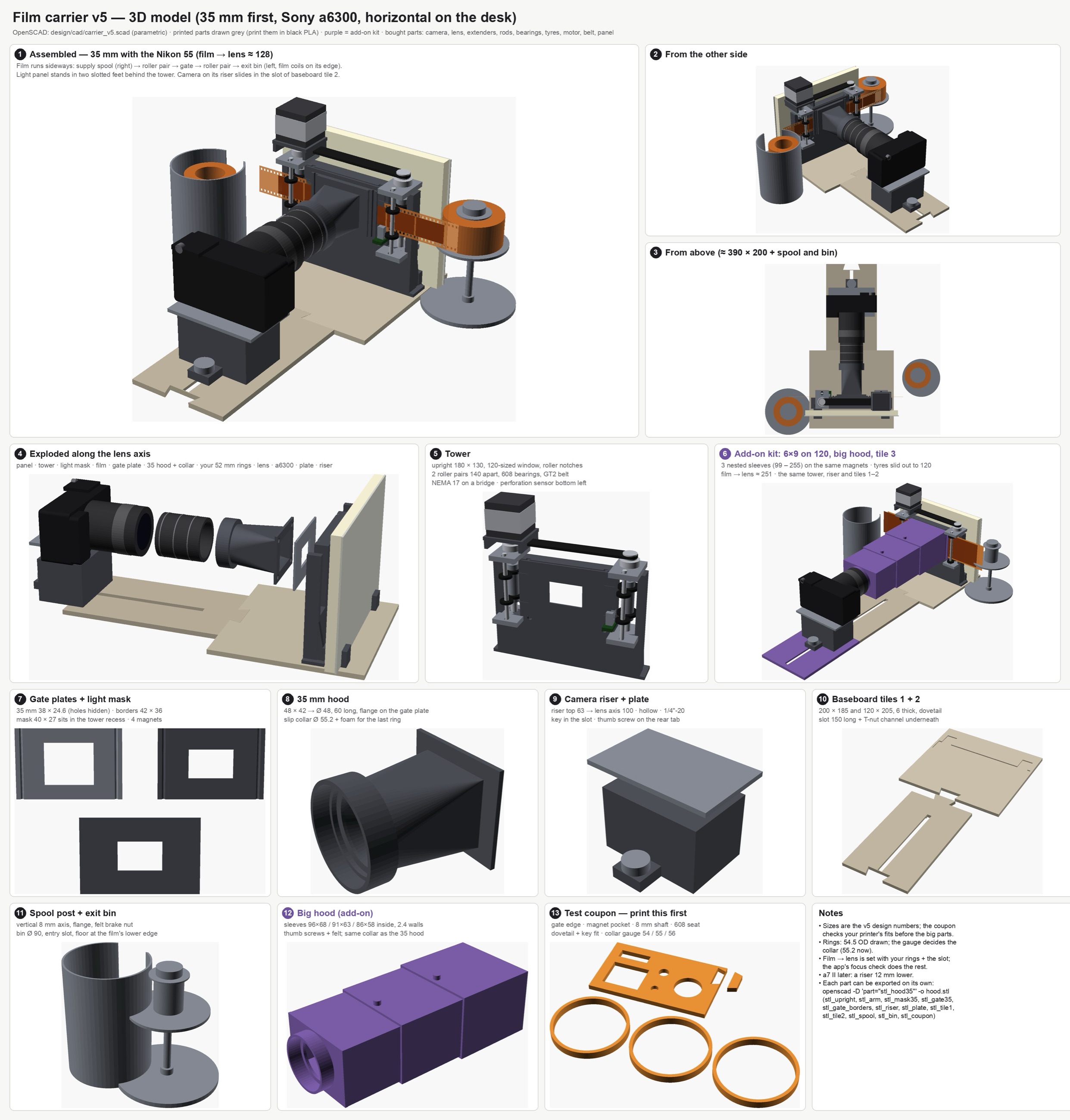
The film stands upright and runs sideways: from the supply spool, through a roller pair, past the gate, through a second roller pair and into a round exit bin where it coils on its edge. No take-up motor, nothing to synchronise.


A motorised film carrier you print yourself. Load a roll, centre the first frame, press Start roll: the scanner advances the film frame by frame while your camera and Cult Darkroom shoot, check, centre and crop every frame.
Feed the strip or uncut roll through the gate and centre the first frame, by hand or with the jog buttons on the Scan page. Press Start roll.
From that first frame the app learns where the frame sits in the view and how wide the gaps between frames are. A one-time calibration measures how far the film moves per motor step.
For every frame: advance one frame, find the gaps in the live view and correct the position, let the vibration settle, capture. Focus, clipping and "film did not move" are checked on each shot.
Each RAW is autocropped to the frame edges (kept as a setting, the RAW itself untouched) and lands in Cult Darkroom, ready to invert. The scanner stops and asks only when a frame looks wrong or the strip ends.
The film stands upright and runs sideways: from the supply spool, through a roller pair, past the gate, through a second roller pair and into a round exit bin where it coils on its edge. No take-up motor, nothing to synchronise.
One NEMA 17 stepper turns the rollers through a belt, run by a TMC2209 driver in silent mode: exact, repeatable moves and no hum during the exposure. Rubber tyres touch only the film edges, never the picture.
The gate is tight across the film and hides the sprocket holes, and a little longer along it so a sliver of the gap between frames shows for centring. An IR sensor outside the picture counts the holes, so even blank or night frames land in place.
Built first around a Sony a6300 with a Nikon 55 mm Micro or TTArtisans 40 mm macro on 52 mm extenders. The camera sits on a printed riser that slides in the baseboard slot; a light-tight hood connects lens and gate.
Medium format and panoramas on the same tower: 120 gate plates (6 × 4.5 to 6 × 9), the longest panorama a 6 × 9 camera makes on 35 mm, a telescoping three-sleeve hood and a third baseboard tile. Big frames can be shot in one go or as 2 – 5 overlapping tiles along the film, stitched automatically: up to ≈ 53 MP from a 6 × 9.
Until then, scan with any holder and develop your negatives in Cult Darkroom.