Felt that never scratches
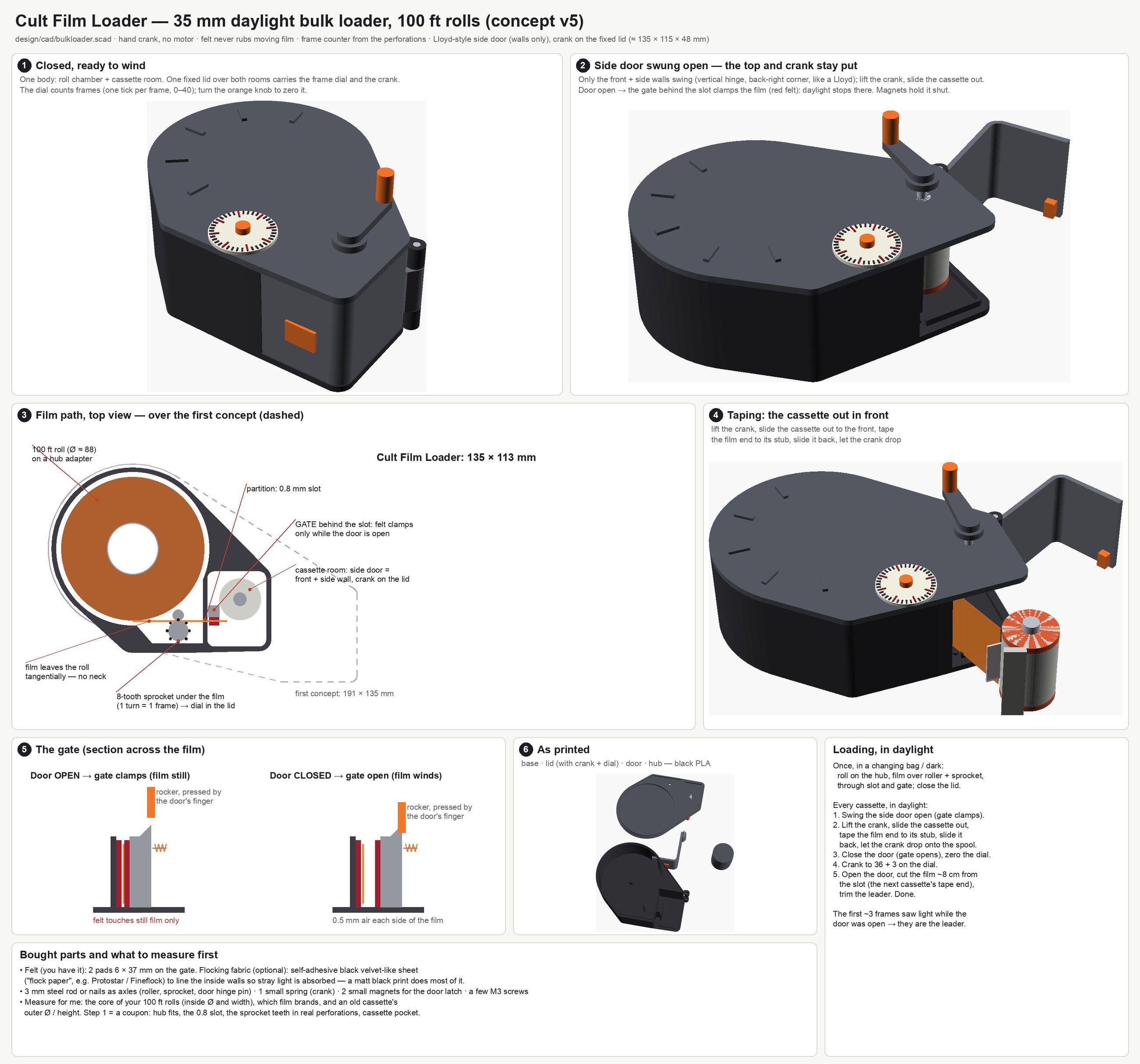
In most loaders the film is pulled through felt, and a grain of grit becomes a scratch along the whole roll. Here the felt pads clamp the film only while the door is open, when the film stands still. With the door shut, a finger on the door pushes the gate open, so the film winds through with half a millimetre of air on each side.
A Lloyd-style side door
Only the front and side walls of the cassette room swing open, on a hinge at the corner. The lid, with the crank and the dial, stays put. The cassette slides out to the front, so you have room to tape it properly, and two magnets hold the door shut. A rib in the floor and one in the lid close the seam against light.
A counter that reads the film
An 8-tooth sprocket runs in the perforations under the film. One turn of the sprocket is 8 perforations, which is exactly one frame (38 mm). It drives a 40-step dial in the lid, so the count comes from the film itself and not from guessing turns of the crank.
Your old cassettes, your cores
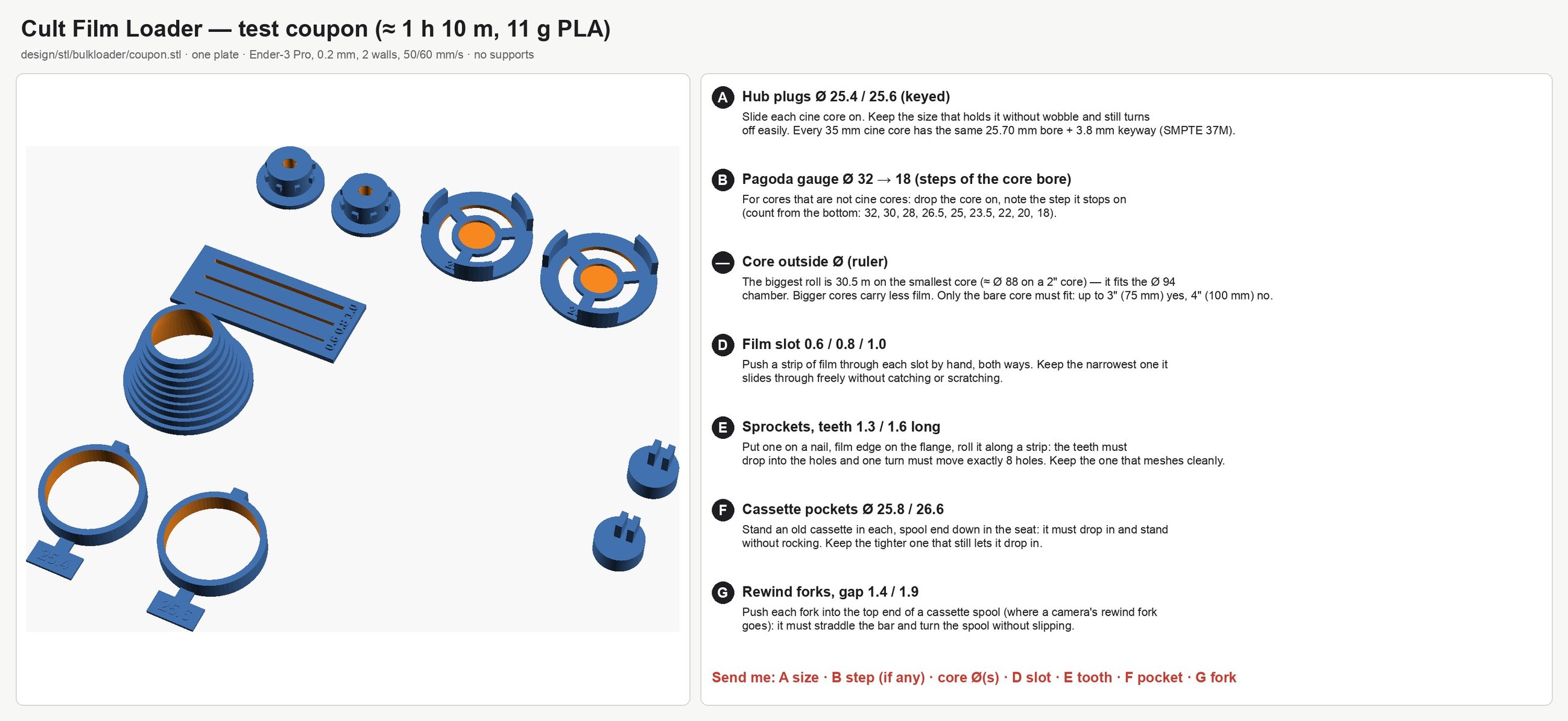
Reuse old commercial cassettes, taped to the film like at the lab. The hub takes standard 35 mm cine cores (SMPTE 37M, 25.7 mm bore with a key), and a 100 ft roll on the smallest core fits the 94 mm chamber. Cores up to 3″ fit. A two-prong fork on the crank turns the cassette spool.
- FILM
- 35 mm, 100 ft (30.5 m) rolls
- CASSETTES
- Old commercial cassettes, film taped on
- CORES
- 35 mm cine cores up to 3″ (75 mm)
- SIZE
- ≈ 135 × 115 × 48 mm
- PRINT
- ≈ 12 h, ≈ 160 g of PLA on any 220 mm bed
- ALSO NEEDED
- Felt, a 3 mm rod, a small spring, 2 magnets, M3 screws